A Planned City Built Around Lakes and Creeks
Peachtree City was laid out on purpose. Settled in 1959 and incorporated in 1962, it is organized into five villages, Aberdeen, Braelinn, Glenloch, Kedron and Wilksmoor, linked by more than 100 miles of multi-use paths. Water was part of the plan from the start. Flat Creek was dammed in 1957 to create Lake Peachtree, Lake Kedron to the north feeds it through Flat Creek during dry spells, and the 650-acre Lake McIntosh opened in 2013. Line Creek, a tributary of the Flint River, forms the western edge of the city.
Those lakes and greenbelts are a big reason people move here. They also mean that some homes sit near water or in low ground along creeks and drainage paths. Rainfall averages roughly 51 inches a year and is spread fairly evenly across the seasons, so wet spells can happen any month.
Checking Flood Zones in Fayette County
Fayette County participates in FEMA's National Flood Insurance Program, so federally backed flood insurance is available for buildings throughout the county. The county also takes part in FEMA's Community Rating System, a voluntary program that rewards communities for going beyond minimum floodplain standards with discounted premiums.
The county's Environmental Management Department keeps Flood Insurance Rate Maps, flood studies and elevation certificates for many properties, and it monitors stream conditions on waterways that include Line Creek below Lake McIntosh and the Flint River. If you live near a lake shore, Flat Creek or Line Creek, it is worth asking whether an elevation certificate exists for your home and looking up your address on Fayette County's floodplain management page or FEMA's Flood Map Service Center.
Remember that standard homeowners policies generally exclude flood, and new NFIP policies typically have a 30-day waiting period before coverage starts.
Severe Storms Moving Through the South Metro
Wind can be as much of a water problem as rain. In March 2021, a low-end EF4 tornado with winds up to 170 mph tracked 38.5 miles across Heard and Coweta counties and into Fayette County, causing heavy damage in neighboring Newnan. Tropical remnants also reach this part of Georgia: Hurricane Helene in 2024 brought 6 to 14 inches of rain and 50 to 80 mph gusts to parts of the state, including 13.89 inches near McDonough.
Peachtree City's tree canopy along the path system and around the lakes is part of its character, but a falling limb can puncture a roof in seconds. Storm damage cleanup typically starts with tarping roof openings, then removing soaked attic insulation and drying ceilings and walls before mold can start. Learn more about storm damage cleanup.
The National Weather Service office that issues warnings for 96 north and central Georgia counties is based right here in Peachtree City. Take its warnings seriously, and never drive through water over a road.
If Water Is Spreading Across Your Floor Right Now
- Turn off the water. Use the fixture valve under a sink or toilet, or the main shutoff if you cannot find the source.
- Stay clear of electrical hazards. Keep out of water near outlets, cords and appliances, and leave the breaker panel alone if you would have to stand in water to reach it.
- Identify the type of water. A burst supply line is usually clean (Category 1). A toilet overflow or water that came in from outside can be contaminated, so wear gloves and boots.
- Take photos and video. Get the source, the water and every damaged item on record before anything is moved.
- Protect what you can. Move rugs, electronics and paperwork out of the wet area and put furniture legs on blocks or foil.
- Get extraction started. Call (888) 817-5061 to be connected with a local company for emergency water extraction.
Inside a Typical Peachtree City Restoration Job
Water damage restoration in Peachtree City follows a sequence that local providers adapt to each home or building.
- Moisture mapping. Meters and thermal cameras show how far water spread under flooring and behind walls, including into neighboring rooms.
- Extraction. Standing water is pulled out of carpet, pad, hardwood and tile.
- Selective removal. Saturated drywall, baseboards and insulation are cut away where needed so cavities can dry.
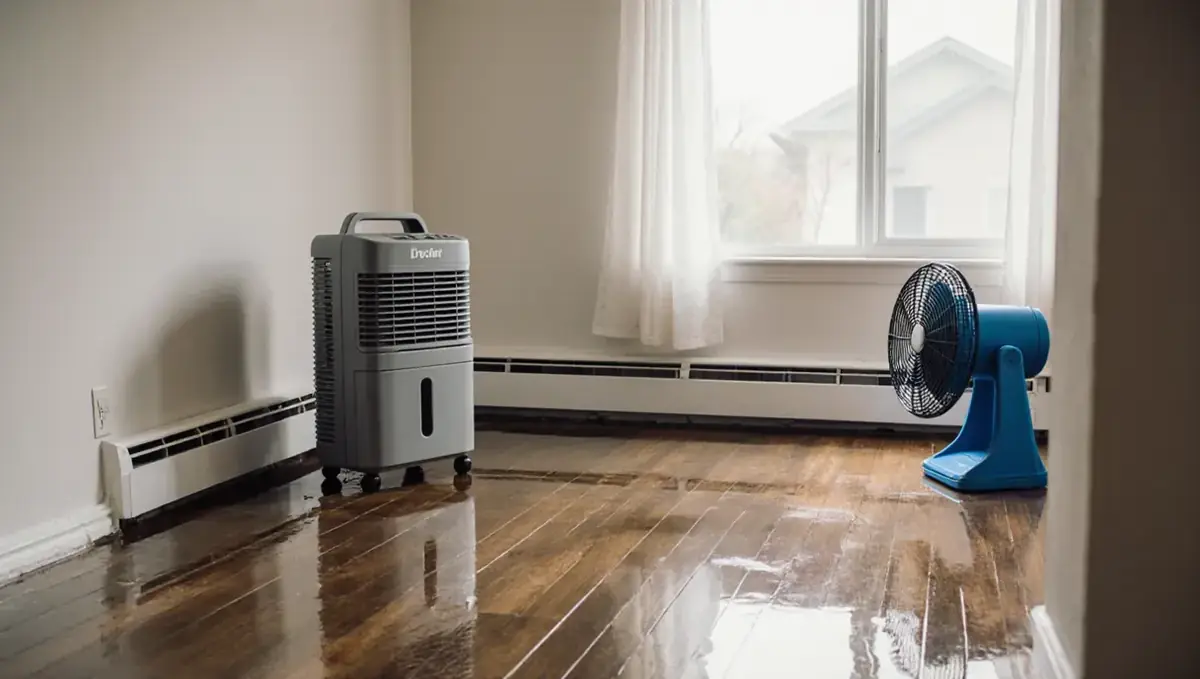
- Controlled drying. Dehumidifiers and air movers run for several days with daily readings. This is where structural drying earns its name.
- Repairs. Once materials test dry, water damage repair restores drywall, paint, flooring and cabinetry.
Georgia licenses residential and general contractors through the Secretary of State. Check a license at verify.sos.ga.gov, and ask about insurance and training such as IICRC certification.
Golf Cart Garages, Lake Lots and Village Centers
More than 10,000 Peachtree City households own golf carts, and many garages hold a cart alongside cars, freezers, water heaters and laundry equipment. Water from a failed water heater or a washing machine hose in a garage can quickly reach an adjoining room, especially where the garage floor sits close to the level of the house.
Lake and creek lots bring a different set of questions: grading, downspout placement and whether stormwater flows toward or away from the foundation. After a heavy rain, walk your lower level and look for damp drywall, lifted flooring or a musty odor.
Shops, offices and restaurants around the city can also be hit by roof leaks, sprinkler line breaks and plumbing failures. Property managers can call (888) 817-5061 to be connected with a provider that handles commercial drying.
Mold Prevention and Georgia's Unclear Rules
Mold can begin to grow within 24 to 48 hours on wet materials, per EPA guidance, and Georgia's humid summers make quick drying important. Hidden moisture under flooring or inside a wall is the usual culprit when mold shows up weeks after a leak seemed to be fixed.
Based on an industry roundup of state requirements, Georgia does not appear to have a state license specifically for mold assessors or mold remediators, though no official Georgia agency statement confirming this was found. That makes it important to ask a company doing mold cleanup in Peachtree City about third-party certification such as IICRC, containment procedures and written moisture readings before and after the job. See the mold removal page for more.
Paperwork That Makes a Claim Easier
Whatever the source of the water, a well-kept file helps. Note the date and time you discovered the damage, report it to your insurer promptly and record the claim number. Keep photos, receipts for emergency purchases and the restoration company's moisture logs and drying reports together. Hold onto damaged items, or photos of them, until the adjuster says they can be discarded.
Georgia's Office of Commissioner of Insurance and Safety Fire can help with questions about your insurer. WaterQ cannot promise any claim outcome, but we can help you take the first step. Call (888) 817-5061, available 24/7.
Peachtree City Villages and Nearby Communities
WaterQ's free referral line connects callers across Peachtree City's villages and nearby Fayette and Coweta County communities with independent local restoration providers.
Neighborhoods
- Aberdeen
- Braelinn
- Glenloch
- Kedron
- Wilksmoor
- Lake Peachtree area
- Lake McIntosh area
Nearby communities
- Tyrone
- Fayetteville
- Senoia
- Sharpsburg
- Newnan
- Brooks
- Woolsey
- Turin
Peachtree City Water Damage FAQ
Is flood insurance available for Peachtree City homes?
Yes. Fayette County participates in the National Flood Insurance Program, so federally backed flood insurance is available for buildings in the county. The county also participates in FEMA's Community Rating System, which can mean discounted premiums. New NFIP policies typically have a 30-day waiting period.
Where can I find an elevation certificate for my house?
Fayette County's Environmental Management Department keeps elevation certificates on file for many properties, along with flood maps and flood studies. Contact the department to ask about your address.
Which waterways should Peachtree City homeowners watch?
Line Creek along the western edge of the city, Flat Creek, which connects Lake Kedron and Lake Peachtree, and the areas around Lake Peachtree, Lake Kedron and Lake McIntosh. Check FEMA flood maps for your specific address.
Can a water heater leak in my garage damage the rest of my house?
Yes. Water can travel under the door into adjoining rooms and wick into drywall and baseboards. Shut off the water to the heater, move belongings off the floor and have the area checked with a moisture meter.
Does WaterQ have its own crews in Peachtree City?
No. WaterQ is a free referral service. We connect you with an independent, local restoration company that performs the inspection and the work.
Local emergency and flood resources
Official sources for alerts, flood maps and preparedness in and around Peachtree City: